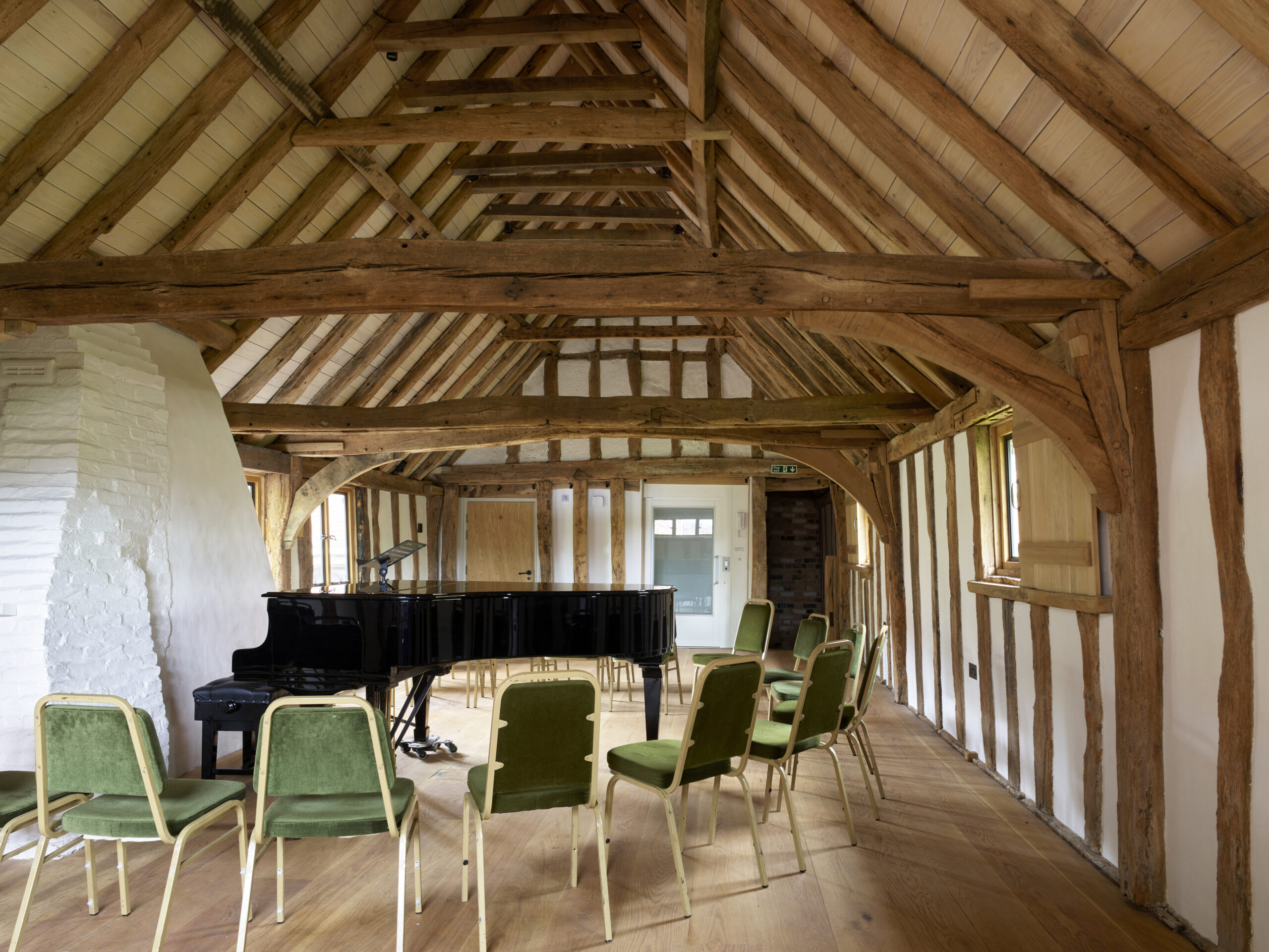
Skinners’ Hall is a Grade I Listed Building and Scheduled Ancient Monument on a site that has been home to the Worshipful Company of Skinners for over 700 years. Made up of four buildings, (Walbrook House, the Court Rooms, a Banqueting Hall and the Georgian Dowgate Range) and a courtyard, the Livery Company has evolved over centuries to include various rebuilds and alterations of many different ages.
The vision for this project was to celebrate the Company’s fascinating history and improve accessibility, circulation and energy efficiency in its premises. The project has also given new purpose to previously unused spaces within the Hall.
Blending Old with New
Extensive repair, renovation and decorating works have improved members’ areas, staff accommodation and offices, as well as providing new and improved event space.
On Dowgate Hill, the building’s façade has been carefully restored, welcoming visitors into a newly designed reception area. Here, the iconic staircase has been beautifully restored and its cantilever design has been mirrored in three new staircases of Portuguese blue limestone. These staircases have unlocked circulation in the main area of the Hall and bring daylight down to the basement along with new skylights.
The first floor now features a new suite of rooms, offering versatile spaces for entertainment, breakout sessions, and a variety of commercial uses, while remaining accessible for members to enjoy. All staff have been relocated to the second floor, bringing the team together on a single level. Continuing up the number 8 staircase to the top floor is the renovated accommodation for the Hall Steward and Master.
The vaulted basement which was previously used for storage has been reinvented as a historic dining experience complete with underfloor heating. Some parts of the basement date back to before the Great Fire of London in 1666. The vaults are now accessed via the Southern Courtyard, a newly created second entrance on College Street.
Adjacent to the renovated courtroom – the beating heart of Skinners’ – the level of the roof terrace has been raised to provide equal access between the two areas and provide a unique entertainment space. In the corner of the roof terrace, a new oak pavilion with striking glass windows has been constructed to provide shelter, a servery area for catering and a new lift and staircase.
On the ground floor, the entire floor of the garden has been raised to allow step free access.
A bomb-damaged fifth building, linking the Dowgate Range and Outer Hall, has been revitalized with the replacement of its top two storeys housing offices and accommodation with the addition of a striking sawtooth roof.
Decoration works have restored the wow factor to the Banqueting Hall and Skinners’ famous Brangwyn murals on the walls are brought to life with new lighting.
A key aim of the project was to strip back insensitive 20th Century alterations and create a harmonious blend between old and new. Many historic features have been discovered, restored and preserved, to make the story of the building’s history more visible. During the strip out of the hall a magnificent kitchen range was found in the dedicated member’s area in the basement, and in the ladies changing room a lead sink has been preserved that is thought to have been used for trade purposes.
Retrofit Design
All engineering services within the hall have been overhauled, meeting the city’s aspirations for net zero carbon emissions by 2040.
Reliance on gas has been replaced completely by transforming the Outer Hall’s pitched roof into a flat roof for the installation of air source heat pumps. The spaces that previously housed the gas boilers have been repurposed for staff facilities and offices. Materials have been reused wherever possible and new materials were sought from sustainable resources such as insulation made from recycled wood fibre. Fireplaces and chimneys have been adapted to serve as fresh air inlets and outlets, with new cables, ductwork, and pipes carefully integrated into the fabric of the old buildings.
The Challenges
A stone’s throw from Cannon Street Station, the hall is situated on a very narrow street and is locked in by buildings on both sides, creating a very tight construction site. The project team had to adjust traditional methods to work around the site constraints and the sensitivity of the Grade I listed building.
A temporary roof encapsulated the whole site to enable the replacement of the roof to the front of the Hall, the creation of a new flat roof above the Outer Hall and changes to the floor level in the Roof Garden.
With limited access to the Hall, a scaffolding arrangement allowed for the creation of an innovative lifting platform for delivering materials across the entire site.
It’s no surprise that refurbishing and retrofitting a 17th century building would present various physical and regulatory challenges and the project team unveiled numerous discoveries as the project progressed. This included finding and consolidating a medieval culvert underneath the basement that once carried the Walbrook River through the city of London out to the Thames.
During construction, historic artwork, furniture and chandeliers had to be carefully removed and stored offsite for safekeeping.